A little ink. Infinite possibilities.
Screen Printing: A Working Guide to Techniques, Equipment and Studio
Screen printing pushes ink through a stencil held on a mesh screen, leaving a print on paper, fabric or another surface. Each colour is printed separately, so the image is built one layer at a time. This screen printing guide follows the work in the order a printer does it.
Start with the process
Where to Start in This Screen Printing Guide
They build on each other in that order. Taken separately, each page stands on its own, and the one most people want first is rarely the first one in the list.
What is screen printing?
The process from artwork to finished sheet, and an honest account of where the method beats digital printing and where it does not.
Follow the processTools of the trade
Mesh counts, ink families, squeegee hardness and emulsion. Which numbers matter and which are a distraction.
See the equipment
Your table, your first print
A DIY setup without a press, working around the dark room you do not have, and the four mistakes beginners make first.
Start printingLayers, colour and happy accidents
The screen printing techniques that change what a print can do: stencil methods, halftones, multi-colour registration, split fountain and overprinting transparent inks.
Dive deeperInk, a mesh, a rubber blade, and a stencil that decides where the ink is allowed to land. The principle has not changed for a very long time, and the things that make one print better than another are still the same things: how well the stencil was made, how flat the screen sits, and how steadily the blade was drawn across it.
This screen printing guide covers the process end to end, along with the practical decisions that sit inside it.
Techniques and Equipment, in the Order They Bite
Most guides are organised by topic, so equipment sits in one chapter and screen printing techniques in another. This one follows the physical order of the work instead, because that is the order in which mistakes get made and the order in which they stop being fixable.
A screen coated unevenly cannot be rescued at the exposure stage. A stencil exposed for the wrong time cannot be rescued during wash-out. A frame mounted flat against the paper cannot be rescued by squeegee technique, however good it is. Each stage inherits every decision before it, which is why a printer with modest equipment and careful preparation beats a well-equipped one in a hurry.
That order also explains why the equipment pages and the technique pages keep pointing at each other. Mesh count is an equipment question until you try to print a halftone, at which point it becomes the whole technique. Ink family is a purchasing decision until a screen blocks halfway through a run. Almost nothing here is cleanly one or the other.
The Studio Behind the Domain
ottoGraphic is the studio name of Otto Dettmer, a graphic artist, illustrator, screen printer and book artist. He graduated in Graphic Design from Bristol Polytechnic in 1991 and completed an MA in Illustration at Kingston University in 1996, after which he began making and publishing screen-printed books — and he is still making and publishing them. The screen printing workshop near Bath that produced the editions catalogued here ran from 2010 until 2019; the practice itself did not end with it.
The work draws on Russian Constructivist design, Polish poster art and Renaissance painting, and it has been shown at artists’ book fairs in London, New York and Germany. In 2019 the studio received the Förderpreis of the Minipresse fair in Mainz for its artists’ books.
The archive of that studio work sits alongside this screen printing guide: the artists’ books, the screen prints, and the editorial illustration. The books are the part worth looking at even if the technical pages are what brought you here, because they show what the process does when nobody is trying to make it efficient: small editions, hand-bound, printed a colour at a time over weeks.
One Thing Worth Knowing Before Buying Anything
The temptation is to buy a press. Presses are visible, expensive and satisfying, and they solve a problem most beginners do not have yet.
The kit that matters at the start is dull, and it moves the result more than any press.
The things that actually limit early work are a second screen, a repeatable exposure time, and enough off-contact. A second screen removes the wait while the first one dries. A tested exposure time removes the most common cause of a ruined stencil. Two millimetres of off-contact removes the smearing that beginners usually blame on their own technique. None of the three costs much, and all three change the results more than any press.
Buy the press later, when the bottleneck is genuinely speed. The studio kit that matters at the start is dull, and it is the part this guide keeps returning to.
None of this is an argument for buying badly. A squeegee with a worn blade and a frame that has gone out of true will cost more time than they ever saved, and both are easier to notice once the basics are in place.
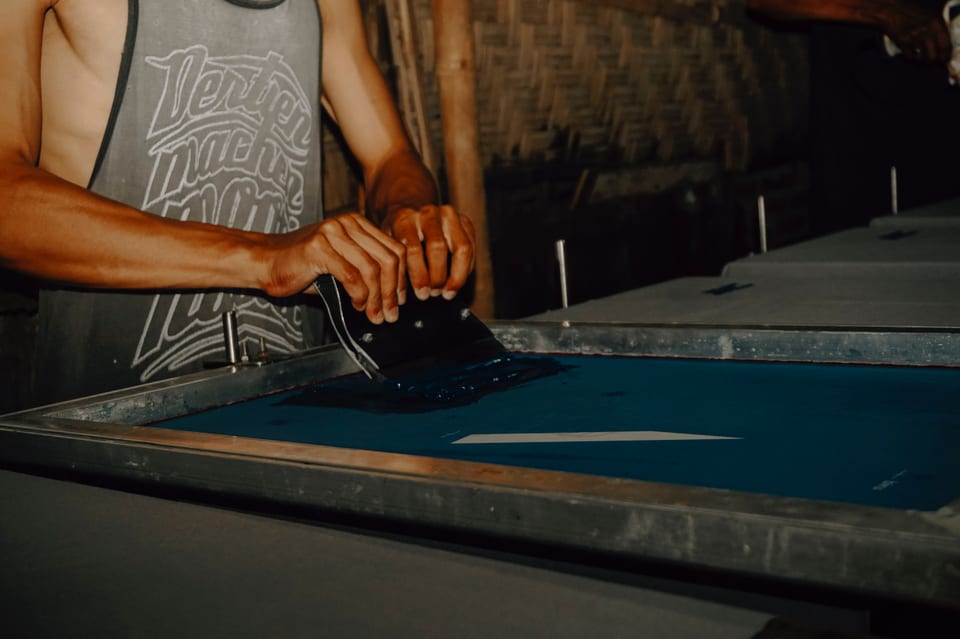
Ink is sold by weight and by base. Ink for screen printing is stocked by suppliers who mix to order, which matters more than brand once a job needs a colour matched twice.
Frequently Asked Questions
Do you need a studio to start screen printing?
No. A kitchen table, a darkened bathroom for coating and drying screens, and a flat board to print on will carry a first edition. What a studio buys is space to leave work set up between sessions, which matters once the runs get longer.
How much does it cost to set up for screen printing?
A home setup with two frames, a squeegee, emulsion and ink runs to roughly £60 to £120. A studio with a press, an exposure unit and a washout booth is an order of magnitude more, and neither produces a better print on its own.
Can screen printing reproduce photographs?
Yes, through halftones. The image is broken into dots of varying size and the eye reads the field of dots as a tone. The dots stay visible at close range, which is often the reason for choosing the method.
How long does it take to learn screen printing?
A single-colour print on paper is achievable on a first attempt with a prepared screen. Reliable registration across two or three colours usually takes a few sessions, and a repeatable exposure time is the thing that takes longest, because it has to be tested for each emulsion and lamp.
What can be screen printed on?
Paper, card, fabric, wood, glass, metal and most plastics. The ink family changes with the surface; the process does not.
Which screen printing techniques suit a beginner?
Photo emulsion stencils with a single colour, on paper, at a mid-range mesh count. Add a second colour once registration is reliable, and leave halftones until the exposure time is known.